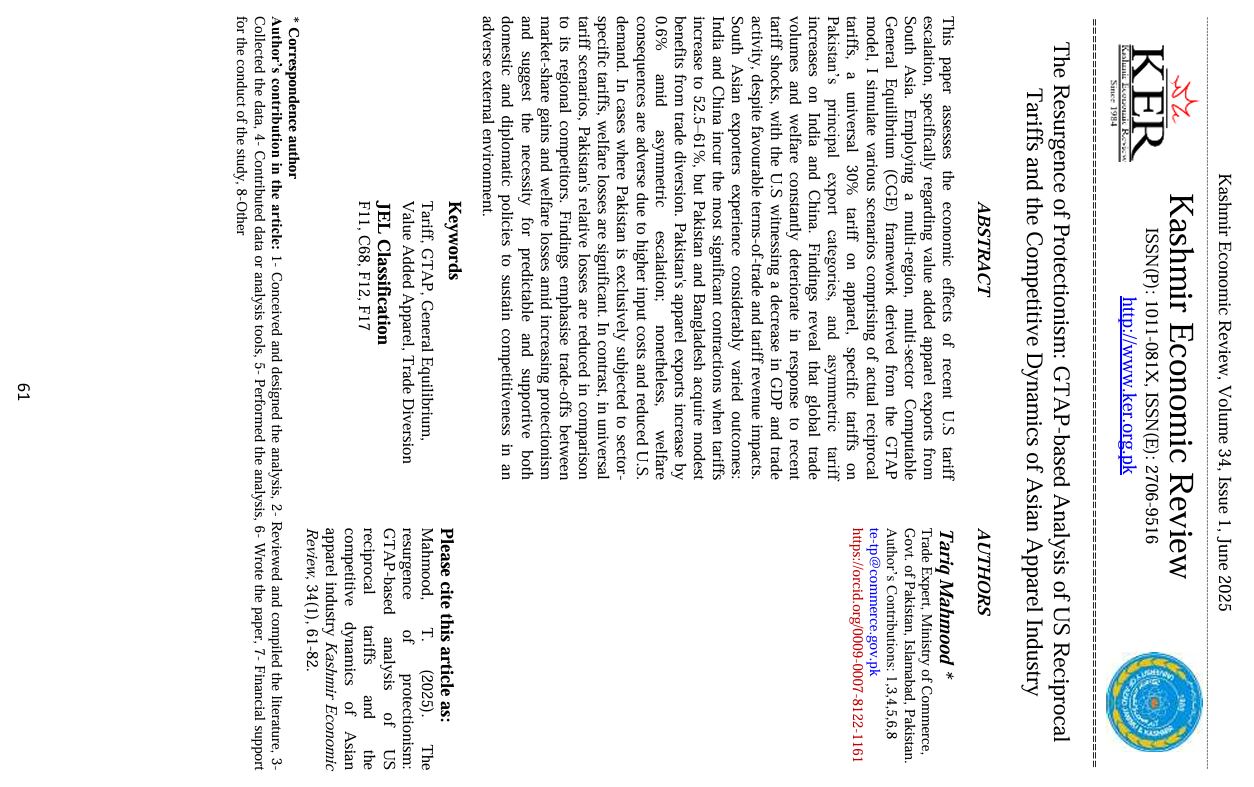
The Resurgence of Protectionism: GTAP-based Analysis of US Reciprocal Tariffs and the Competitive Dynamics of Asian Apparel Industry
##plugins.themes.bootstrap3.article.sidebar##
##plugins.themes.bootstrap3.article.main##
چکیده
This paper assesses the economic effects of recent U.S tariff escalation, specifically regarding value added apparel exports from South Asia. Employing a multi-region, multi-sector Computable General Equilibrium (CGE) framework derived from the GTAP model, I simulate various scenarios comprising of actual reciprocal tariffs, a universal 30% tariff on apparel, specific tariffs on Pakistan’s principal export categories, and asymmetric tariff increases on India and China. Findings reveal that global trade volumes and welfare constantly deteriorate in response to recent tariff shocks, with the U.S witnessing a decrease in GDP and trade activity, despite favourable terms-of-trade and tariff revenue impacts. South Asian exporters experience considerably varied outcomes: India and China incur the most significant contractions when tariffs increase to 52.5–61%, but Pakistan and Bangladesh acquire modest benefits from trade diversion. Pakistan's apparel exports increase by 0.6% amid asymmetric escalation; nonetheless, welfare consequences are adverse due to higher input costs and reduced U.S. demand. In cases where Pakistan is exclusively subjected to sector-specific tariffs, welfare losses are significant. In contrast, in universal tariff scenarios, Pakistan's relative losses are reduced in comparison to its regional competitors. Findings emphasise trade-offs between market-share gains and welfare losses amid increasing protectionism and suggest the necessity for predictable and supportive both domestic and diplomatic policies to sustain competitiveness in an adverse external environment.
##plugins.themes.bootstrap3.article.details##

این پروژه تحت مجوز بین المللی Creative Commons Attribution-ShareAlike 4.0 می باشد.